

Introduction to the Bible
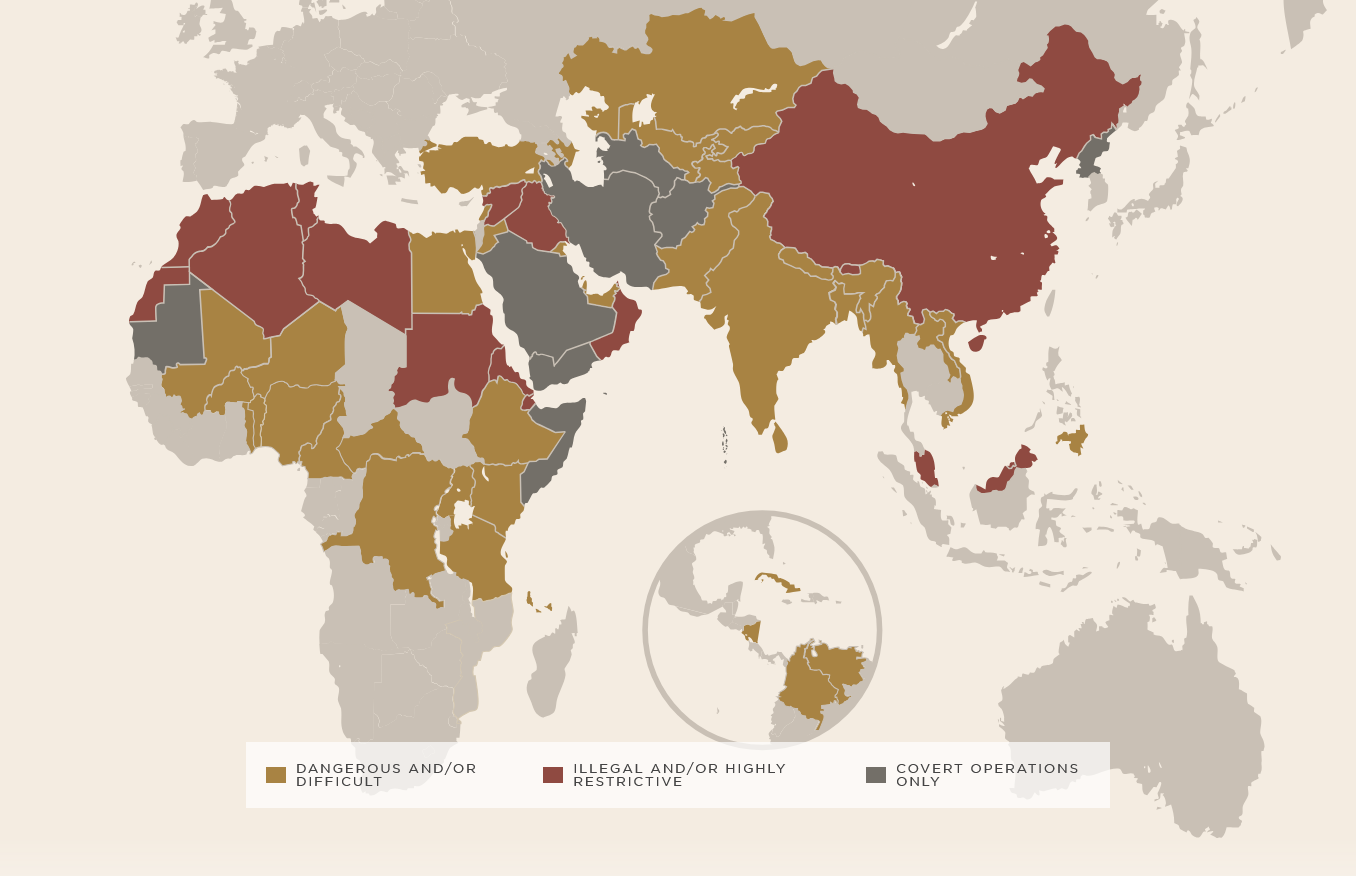
The Bible has been printed, distributed and translated more than any other book in the history of the world, no other book even comes close. Nor do any other ancient works compare to the volume or accuracy of the Bible’s preserved copies. And, the many efforts of wicked men to eliminate this book have all failed. This preservation over thousands of years serves as overwhelming proof of God’s sovereign plan for the Bible! Down through the ages, many have been willing to suffer to own this book. Even today, there are 52 countries where the Bible is illegal or restricted, and one could be persecuted, imprisoned or put to death by owning or sharing it (see map below from persecution.com).
There is no greater tangible asset in this world! Many books offer valuable information, but the Bible offers something no other book can – spiritual truth. Science books offer fascinating observations of the natural world around us but leave us with no options for escaping death. Unlike Philosophy that encourages one to merely ponder, the Bible seeks a response from it’s readers and promises results.
The Bible is the foundation for God to reveal himself, which provides an understanding of human life which was modeled after him. Since God is the source of life and his words reveal the truth about himself, everything he says contains life and truth! God and his word are so inseparable that he even refers to himself as "The Word".
“In the beginning was the Word, the Word was with God, and the Word was God.” (Jn 1:1)
The Bible is a book of history that helps us learn from the past, but also a book of prophecy that tells us what to expect in the future. At its heart, it’s an epic love story about a God who loves the humans he created and longs to be loved back. Nothing equals the passion of our God who is willing to relentlessly pursue those he loves, at any price!
If you approach the Bible as a text book, you will miss the life-giving power found on its pages. The goal is not to know the Bible, but to know Jesus Christ. God’s word was intended to build relationship, not religion. Many theologians have made the mistake of filling their head instead of their hearts. Many crooked preachers know the Bible very well, but deliberately keep their distance from the author.
This telling of God’s story is a beautiful tapestry woven with a diverse and colorful array of characters. There are kings, priests, prostitutes, slaves, mystics, doctors, fishermen, and tax collectors, facing remarkable situations in exotic settings. It’s surprisingly honest, sometimes poetic, and full of heroic humans doing miraculous exploits. The Bible was recorded by more than 35 authors inspired by God, over a period of 1500 years. Some of the authors were educated, well spoken, and had influence, including Kings, Princes, and Governors. Others came from uneducated fields of labor such as farmers and herdsmen.
Finding Your Way Around
The Bible is a collection of 66 books, divided into 2 sections, The Old Testament and The New Testament. The “Old” records and explains God’s relationship with mankind before he came to Earth in a human body as Jesus Christ. The “New” is everything after Jesus came to Earth to establish his plan of salvation for humanity.
Each book of the Bible is divided into chapters, which are divided into verses. This makes it easy to find what you’re looking for, and easy to share with others. A verse of scripture is written like this: John 1:14 (This is the book of John, chapter 1, verse 14). One Bible reference tool everyone should be aware of is the “Concordance”. A Concordance is a book with a list of every word in the Bible in alphabetical order, with references to every scripture that contains that word. Bible websites make this and many other reference tools easily available, complete with search features, cross-references and commentaries.
The Bible was originally written in 3 ancient languages, Hebrew, Aramaic, and Greek, but it has since been translated into the most common modern languages of the world. As of 2025, it can be read, all or in part, in 4007 languages. The more common languages have more than one translation, such as English, which has hundreds.
Different translations in the same language vary slightly in the words they use, because the same idea can be expressed with different words (path, trail, walkway). In English, there are many great translations but none is singularly perfect above all others, and only a few should be avoided altogether. Those obsessed with fighting for a particular translation have missed the point. It’s not a perfect translation that saves, it’s a perfect revelation of Jesus as the Holy Spirit reveals. Online Bibles offer the benefit of looking at multiple translations side-by-side. Here is an example of 2 different translations for the same verse:
"I sought the LORD, and he answered me; he delivered me from all my fears.”
(Psalm 34:4 New International Version)
“I prayed to the LORD, and he answered me. He freed me from all my fears.”
(Psalm 34:4 New Living Translation)
Best English translations for those new to the Bible:
Berean Standard Bible (BSB)
New International Version (NIV)
New American Standard Bible (NASB)
Translations everyone should avoid:
The Passion (TPT)
New World Translation (NWT)
The Message (MSG)
The Living Bible (TLB)
The Mirror Bible
The Clear Word Bible
Where To Start
It may seem odd, but the Bible shouldn’t be read from front to back. If you’re new to the Bible or haven’t opened one in a long time, start with the gospels. The entire Bible is about Jesus, but the gospels are the starting place for understanding who he is, and much of the Old Testament will not make sense without the context of the gospels. The gospels record his time on Earth in a human body - what he did and what he said, as told by those closest to him. Each of the four gospels offers overlapping details presented from different personalities and perspectives. The "Gospel of Luke” is a great place to start!
Books of the Bible are not arranged in chronological order. They are arranged by genre categories in the order listed below:
Old Testament (39 Books)
-
Law - Genesis, Exodus, Leviticus, Numbers, Deuteronomy
-
History - Joshua, Judges, Ruth, 1 Samuel, 2 Samuel, 1 Kings, 2 Kings, 1 Chronicles, 2 Chronicles, Ezra, Nehemiah, Esther
-
Poetry/Wisdom - Job, Psalms, Proverbs, Ecclesiastes, Song of Solomon
-
Major Prophets - Isaiah, Jeremiah, Lamentations, Ezekiel, Daniel
-
Minor Prophets - Hosea, Joel, Amos, Obadiah, Jonah, Micah, Nahum, Habakkuk,
Zephaniah, Haggai, Zechariah, Malachi
New Testament (27 Books)
-
Jesus on Earth [The Gospels] – Matthew, Mark, Luke, John
-
History of the Church - Acts
-
Paul’s letters to churches - Romans, 1 and 2 Corinthians, Galatians, Ephesians, Philippians, Colossians, 1 and 2 Thessalonians
-
Paul’s letters to individuals - 1 and 2 Timothy, Titus, Philemon
-
Letters by others - Hebrews, James, 1 and 2 Peter, 1, 2, and 3 John, Jude
-
Prophecy – The Revelation
Important Facts the Bible States About Itself
The Bible isn’t mere words, it’s full of the supernatural power of God:
“For the word of God is living and active, sharper than any two edged sword…” (Heb 4:12)
It’s powerful and life-giving because it came out of God’s mouth:
“All Scripture is God-breathed...” (2 Tim 3:16)
The truth spoken by God is a source of life for humans:
“...humans shall not live on bread alone, but on every word that comes from the mouth of God.” (Matt 4:4)
The essential faith needed to grow in Jesus comes through his word:
“So faith comes from hearing, and hearing by the word of Christ.” (Rom 10:17)
God’s word reveals the dirty places in your own soul that need cleansing:
“Christ loved the church and gave himself up for her to make her holy, cleansing her by the washing with water through the word…” (Eph 5:26)
God’s word is a source of heavenly guidance for all you do in life:
“Your word is a lamp for my feet, a light on my path.” (Ps 119:105)
Final Thought
The word “Bible” comes from the Greek word Biblia, which literally means “The Book”. This title seems understated, yet in its simplicity, speaks boldly of itself. What could be a more appropriate title for the only book that will still exist and still be relevant after the grave: The Book. Before opening the Bible, pray for God to come near and make himself known. This book will nourish your spirit, but take small bites, chew it thoroughly, and allow it to digest!